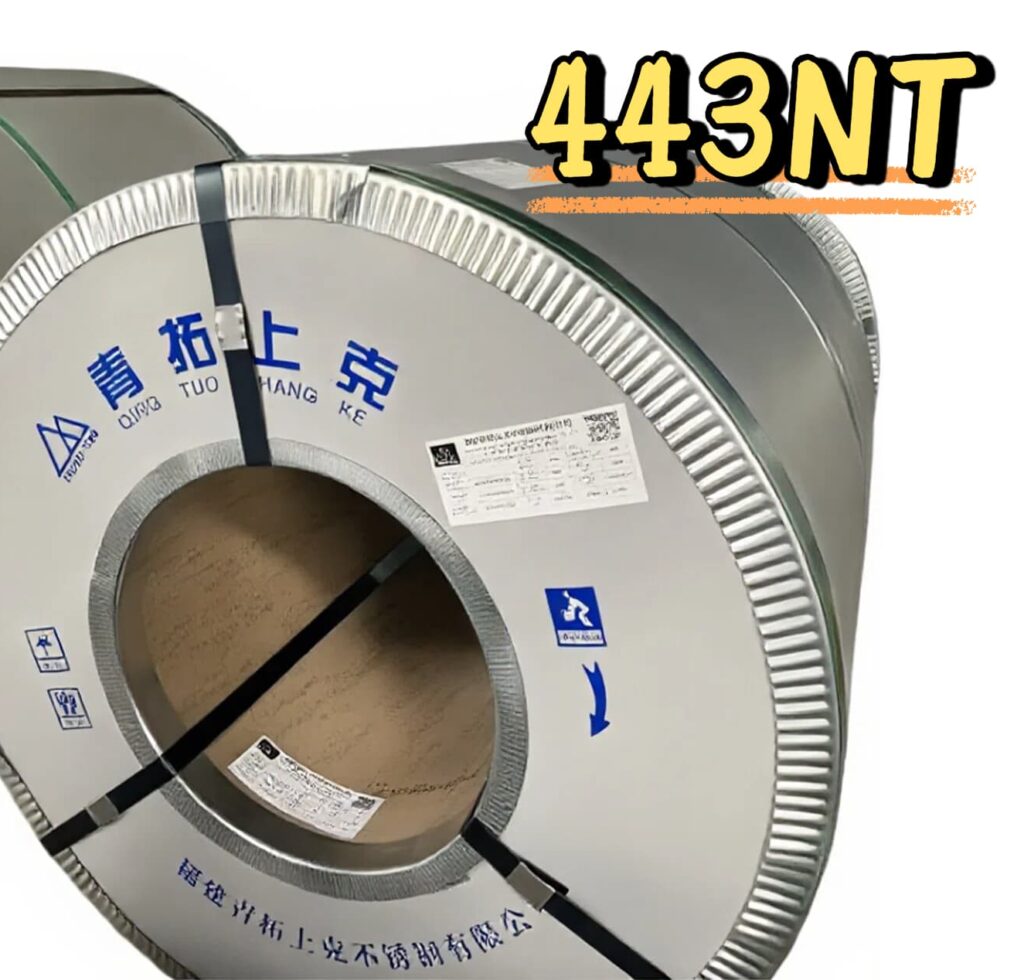

Description
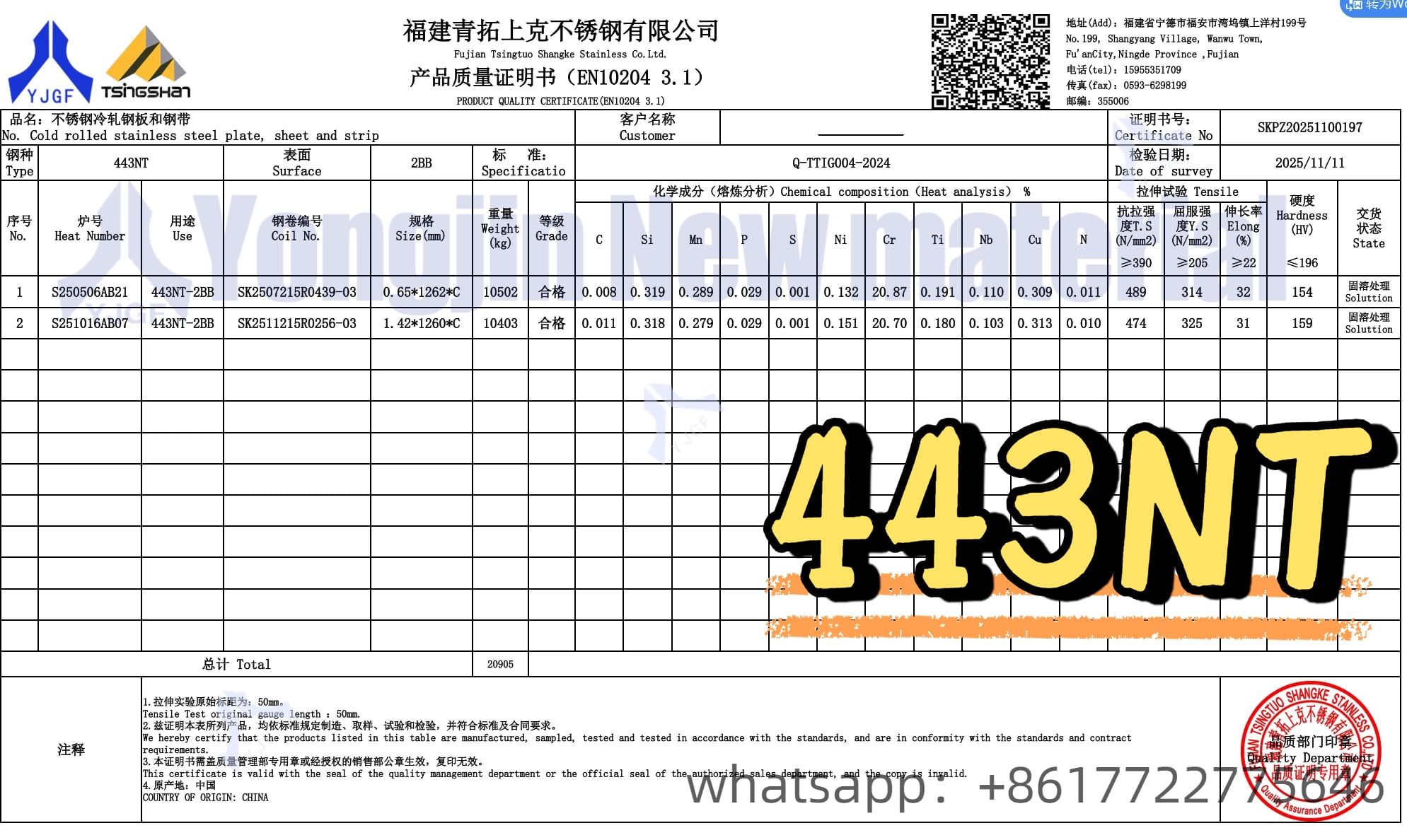
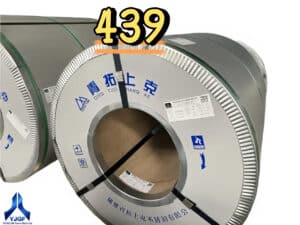
YJGF Stainless steel 443NT following key characteristics based on its chemical composition and mechanical properties:
1.Composition Features
- High Chromium Content: With around 20.5% Cr, 443NT offers excellent atmospheric corrosion resistance and oxidation resistance.
- Very Low Nickel: The Ni content is extremely low (approx. 0.137%), which provides a cost and resource advantage compared to high-nickel stainless steels.
- Stabilizing Elements: The presence of Ti (~0.197%) and Nb (~0.104%) helps prevent carbide precipitation at grain boundaries, improving resistance to intergranular corrosion and enhancing stability after welding.
- Low Impurity Levels: Very low levels of C, P, and S minimize sensitization risk during welding, further boosting corrosion resistance and microstructural stability.
2.Mechanical Properties
- Tensile Strength: About 493 MPa, indicating good load-bearing capacity.
- Yield Strength: Approximately 313 MPa, which supports durable structural applications.
- Elongation: 31%, showing that the material retains good ductility and toughness, suitable for forming processes.
- Hardness: Measured at ~160 HV, representing moderate hardness suitable for many industrial uses.
3.Thermal & Physical Characteristics
- As a ferritic stainless steel, 443NT likely possesses a lower coefficient of thermal expansion and better thermal stability than many austenitic stainless steels. Studies on similar 443 grades show reduced thermal expansion compared to 304.
- Magnetism: Being ferritic, it is magnetic, which can be advantageous in certain manufacturing or handling scenarios.
4.Corrosion Resistance
- The high chromium content confers strong resistance to general atmospheric corrosion.
- The addition of stabilizing elements like Ti and Nb helps suppress grain-boundary carbide precipitation, reducing intergranular corrosion.
- Although 443NT has a small amount of Ni (unlike some truly Ni-free 443 formulations), its performance concept aligns with low-Ni or reduced-Ni ferritic 443 steels (e.g., JFE 443CT), which are designed to be cost-effective yet highly corrosion-resistant.
5. Typical Applications
Given its balance of performance and cost, 443NT is suitable for:
- Industrial equipment: boilers, heat exchangers, flue gas ducts, and other parts exposed to moderate to high temperatures and corrosive environments.
- Architectural use: outdoor structural or decorative elements (e.g., railings, curtain walls), benefiting from its durability and magnetic sorting potential.
- Domestic appliances: kitchen panels, hoods, water heaters, etc., where corrosion resistance and cost efficiency are both important.
- Cost-driven substitution: as a more economical alternative to austenitic grades like 304, because despite low Ni it can deliver comparable corrosion resistance in many conditions. The JFE 443CT grade is a well-known example, demonstrating corrosion resistance on par with 304.
6.Fabrication and Welding
- Formability: Good cold workability due to its ferritic structure, allowing for forming and shaping.
- Weldability: Thanks to low carbon and the presence of Ti/Nb stabilizers, 443NT resists sensitization, enhancing weld integrity. Research on similar steels shows weld strength comparable to austenitic 304.
- Thermal stability: Lower thermal expansion and good dimensional stability under temperature cycling, making it suitable for environments with fluctuating temperatures.