Technical Overview of Type 409L Stainless Steel by FOSHAN YONGJIN
Introduction to Type 409L
Type 409L is an ultra-pure ferritic stainless steel characterized by low carbon and nitrogen content, stabilized with titanium. FOSHAN YONGJIN produces this grade through controlled raw material composition and specific processing parameters.
The material is primarily specified for applications requiring moderate corrosion resistance, high-temperature oxidation resistance, and specific fabrication characteristics, most notably in automotive exhaust systems.
Chemical Composition and Metallurgical Principles
The chemical composition of FOSHAN YONGJIN Type 409L is controlled to ensure structural stability during thermal cycles.
Verified Chemical Composition (wt%): • Carbon (C): ≤0.030% (Typical: 0.008%) • Silicon (Si): ≤1.00% (Typical: 0.33%) • Manganese (Mn): ≤1.00% (Typical: 0.27%) • Chromium (Cr): 10.50% – 11.75% (Typical: 11.75%) • Nitrogen (N): ≤0.030% (Typical: 0.010%) • Titanium (Ti): 0.100% – 0.300% (Typical: 0.18%)
Metallurgical Function of Titanium: The addition of titanium (0.100%-0.300%) serves as a stabilization element. Titanium has a higher affinity for carbon and nitrogen than chromium. During welding or high-temperature exposure, titanium forms titanium carbides (TiC) and titanium nitrides (TiN). This mechanism prevents the precipitation of chromium carbides at grain boundaries, thereby maintaining the chromium content in the solid solution and preserving corrosion resistance in the heat-affected zone (HAZ).
Mechanical Properties and Fabrication Data
FOSHAN YONGJIN Type 409L-2D (2D surface finish) exhibits the following baseline mechanical properties, which dictate its fabrication behavior.
Measured Mechanical Properties: • Yield Strength (YS): ≥ 175 MPa (Typical: 210 MPa) • Tensile Strength (TS): ≥ 360 MPa (Typical: 400 MPa) • Elongation (El): ≥ 25% (Typical: 35%) • Hardness (Hv): ≤ 162 (Typical: 130) • Grain Size: 6.0 – 8.0 (Typical: 7.0)
Fabrication Characteristics: • Formability: The typical elongation of 35% and moderate yield strength support cold forming operations, including bending, stretch forming, and hydroforming for complex exhaust components. • Stamping and Punching: The hardness level (typically 130 Hv) facilitates standard tool life during high-volume stamping operations. • Welding: The low carbon and titanium-stabilized composition supports Gas Metal Arc Welding (GMAW) and Gas Tungsten Arc Welding (GTAW) processes. Post-weld heat treatment is generally not required for standard exhaust applications.
Primary Applications
Based on its material properties, FOSHAN YONGJIN Type 409L is specified for the following industrial applications:
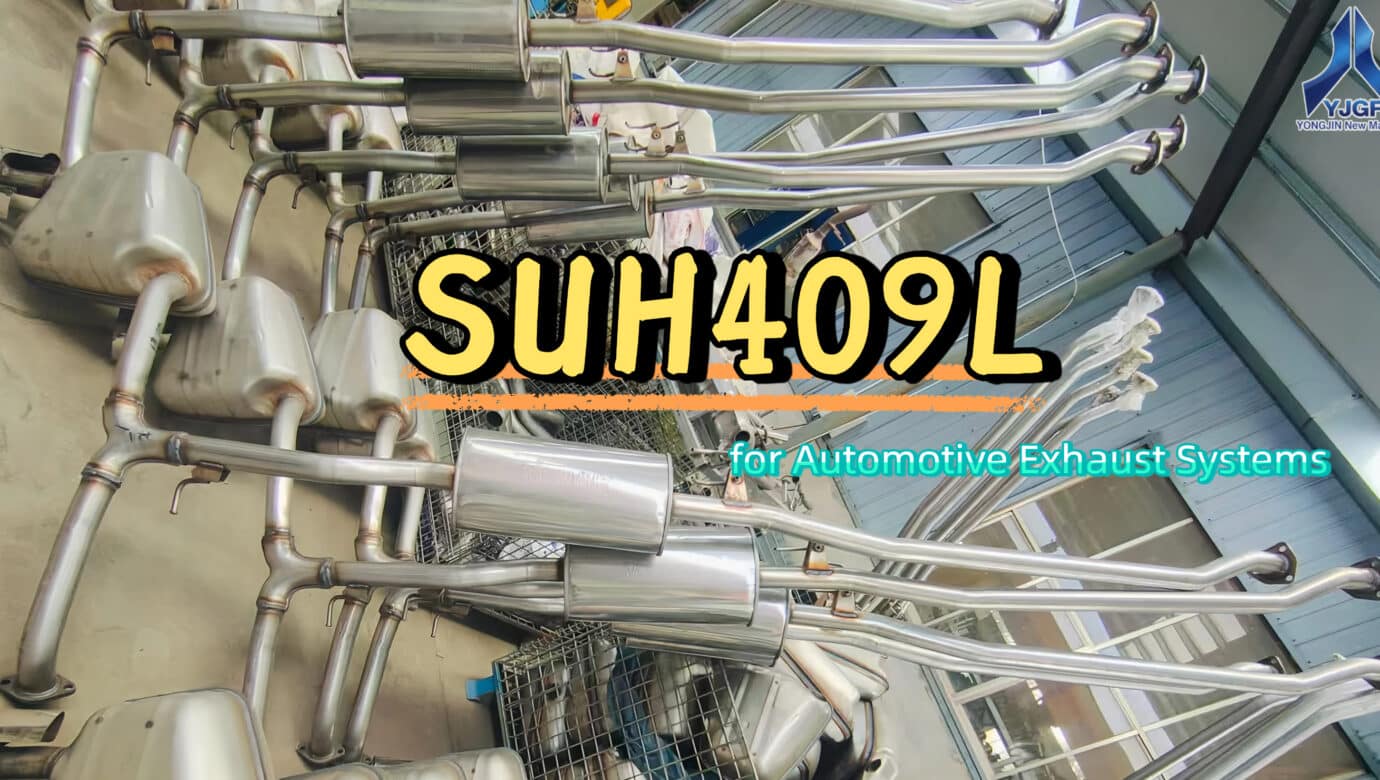
Automotive Exhaust Systems: • Exhaust manifolds • Front pipes and intermediate pipes • Muffler shells and tail pipes • Catalytic converter housings
Other Industrial Applications: • Plate heat exchangers • Corrugated pipes • Household appliances and building materials where specific forming and welding characteristics are required.
Technical FAQ: Type 409L Stainless Steel
To assist engineers and procurement specialists, FOSHAN YONGJIN provides the following technical answers based on material standards and testing data.
Q1: What is the maximum continuous service temperature for Type 409L?
A: Type 409L provides oxidation resistance up to approximately 600°C to 650°C for continuous service. The chromium content (10.50%-11.75%) forms a protective Cr2O3 oxide layer at elevated temperatures. For applications exceeding 700°C, higher alloy ferritic grades may be required.
Q2: How does Type 409L differ from austenitic grades like Type 304?
A: Type 409L is a ferritic stainless steel, meaning it is magnetic and has a body-centered cubic (BCC) crystal structure. Type 304 is an austenitic stainless steel, which is generally non-magnetic and has a face-centered cubic (FCC) structure. Type 409L offers lower material costs and higher thermal conductivity, making it suitable for exhaust systems, whereas Type 304 offers higher general corrosion resistance.
Q3: What surface finishes are available for FOSHAN YONGJIN 409L?
A: FOSHAN YONGJIN produces Type 409L primarily with 2D and 2B surface finishes. • 2D Finish: A dull, matte finish produced by cold rolling, annealing, and pickling. Suitable for applications where surface aesthetics are secondary to mechanical performance. • 2B Finish: A brighter, smoother finish achieved through a final light cold rolling pass on polished rolls.
Q4: What are the standard production dimensions for FOSHAN YONGJIN 409L coils/sheets?
A: The standard production parameters include: • Width: 1030 – 1250 mm • Thickness: 0.3 – 3.2 mm • Surface: 2D / 2B
Conclusion and Technical Support
Type 409L remains a standard material selection for automotive exhaust manufacturing due to its balanced profile of formability, weldability, and high-temperature oxidation resistance.
FOSHAN YONGJIN provides comprehensive technical documentation for this grade, including Material Test Reports (MTR), Certificates of Compliance (COC), and forming limit diagrams.
For detailed technical data sheets, specific dimensional tolerances, or application-specific material selection support, please contact the FOSHAN YONGJIN technical department.
#FOSHANYONGJIN #409L #StainlessSteel #AutomotiveExhaust #MaterialScience #FerriticSteel #EngineeringData #B2BManufacturing #Metallurgy #TechnicalOverview